Mobile App User Acquisition in 2026: Winning Strategies for a Crowded Marketplace
Updated at: June 17, 2025

Proven Organic and Paid Growth Tactics for App Developers in Competitive Markets
“I’ve launched an app, but no one is downloading it.”
“I’m spending money on ads, but installs are low and expensive.”
“I get downloads, but users don’t stay.”
If any of these sound familiar, you’re not alone. These are the top struggles faced by business owners and app creators today — even those with fantastic products!
Launching a mobile app today is like opening a world-class restaurant in the heart of a city packed with thousands of dining options. You may have the best food, a beautifully designed space, and top-notch service — but none of that matters if:
- People don’t know you exist,
- First-time visitors leave confused, or
- Customers don’t come back.
In 2025, the app marketplace is that overcrowded city. Even niche categories feel like rush hour. The challenge isn’t just building a great app — it’s getting discovered, standing out, and creating an experience that keeps users coming back.
The bottom line? If you’re relying solely on ads or word-of-mouth to grow, you’re likely leaving growth on the table.
In this guide, we’ll explore a strategic mix of organic visibility tactics, smart paid campaigns, and insider growth insights to help your app not only survive — but scale with purpose and profit.
- Introduction: The Real Challenge Behind App Growth
- The Two Core Strategies: Organic vs. Paid
-
Organic Acquisition: The Long Game With Big Returns
3.1 App Store Optimization (ASO)
3.2 Content Marketing
3.3 Social Media & Influencer Engagement
3.4 Referral Programs
3.5 Community Building
-
Paid Acquisition: Fast-Track Growth
4.1 Search Ads (Apple & Google)
4.2 Social Media Ads
4.3 Influencer Collaborations (Paid)
4.4 Display & Programmatic Ads
4.5 Email Marketing
-
Metrics That Actually Matter
5.1 Are People Installing Your App?
5.2 What’s Your Acquisition Cost?
5.3 Are Users Bringing Value?
5.4 Are They Sticking Around?
5.5 Are Your Campaigns Converting?
- Bonus Tip: Tools to Track Performance
The Two Core Strategies of App User Acquisition: Organic and Paid
In today’s app economy, every user acquisition effort falls into one of two categories: organic or paid. While some brands rely solely on one path, the most successful apps use both — strategically and in sync.
Think of it like this:
- Organic acquisition is your compound interest — it grows slowly but delivers long-term value.
- Paid acquisition is your rocket fuel — it boosts visibility fast, but it burns through your budget just as quickly.
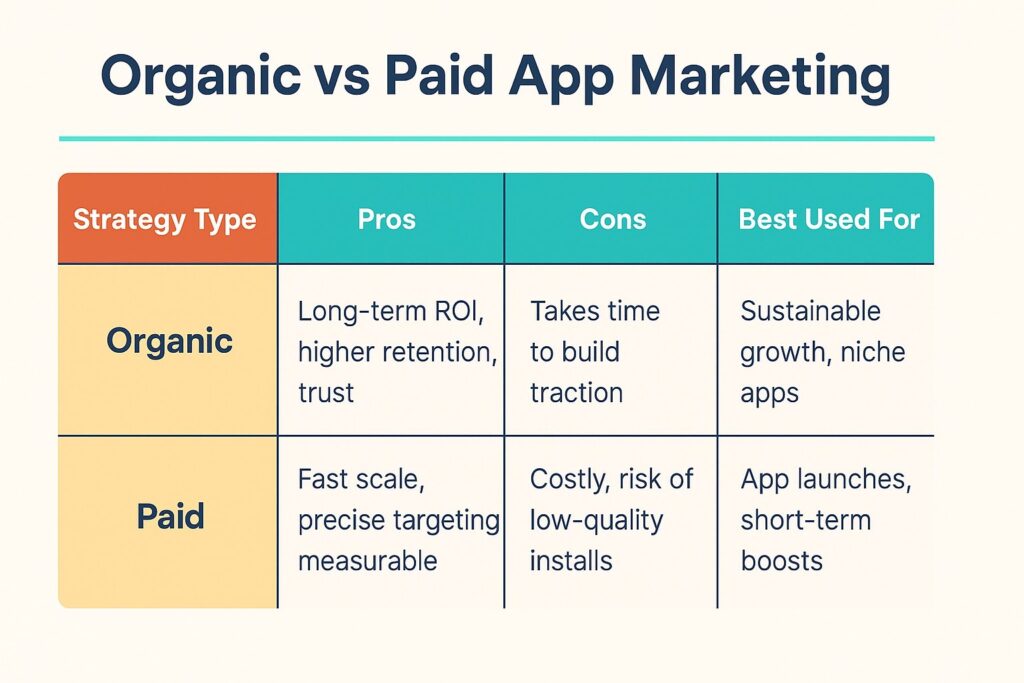
Let’s break each down.
Organic Acquisition: The Long Game With Big Returns
Organic user acquisition focuses on attracting users without paying for every click or install.
While it takes time and consistency, the payoff is massive: higher retention rates, stronger user loyalty, and lower long-term costs.
📖 Want to know where the real ROI lies — mass-market or niche apps?
Don’t miss our deep-dive: Mass-Market vs. Niche Mobile Apps: Where’s the Real ROI Today?
Here are the top organic strategies to consider:
✅ 1. App Store Optimization (ASO)
Your app store listing is your digital storefront. If it’s not optimized, users won’t find or trust your app — no matter how good it is.
What to focus on:
- Title & subtitle keywords
- Icon & screenshots
- Ratings & reviews
- Compelling app description with benefits and keywords
✅ 2. Content Marketing: Attract With Value Before the Install
What to focus on:
- Write SEO-optimized blogs that solve user problems related to your app’s niche.
- Create explainer videos, how-to guides, or feature walkthroughs.
- Turn your user feedback and FAQs into high-value content pieces.
- Share real success stories and use cases to build credibility.
Example: A mental wellness app could publish “5 Breathing Exercises to Reduce Anxiety” with a soft CTA to download the app for guided meditations.
✅ 3. Social Media & Influencer Engagement: Build a Buzz, Organically
What to focus on:
- Pick platforms where your target audience hangs out (e.g., TikTok for Gen Z, LinkedIn for B2B).
- Post bite-sized content: reels, memes, feature demos, user testimonials.
- Engage in real conversations via comments and DMs — don’t just broadcast.
- Collaborate with nano or micro-influencers (under 50K followers) for authentic reach.
Tip: Use trending sounds and hashtags to ride the algorithm wave while staying brand-aligned.
✅ 4. Referral Programs: Turn Happy Users Into Your Sales Team
What to focus on:
- Design a simple and compelling incentive: credits, discounts, exclusive access.
- Make sharing easy — one tap from within the app or on the thank-you page.
- Track and reward both the referrer and the new user.
- Highlight referral options during onboarding and after major in-app milestones.
Example: Fintech app Cred grew significantly by rewarding users with cashback for every friend invited.
✅ 5. Community Building: Create a Tribe Around Your App
What to focus on:
- Create branded spaces on Facebook Groups, Reddit, Telegram, or Discord.
- Appoint moderators or community managers to maintain activity.
- Encourage user-generated content, feedback, and testimonials.
- Offer exclusive content, beta access, or AMA sessions to keep users engaged.
Tip: Gamify engagement — award badges, levels, or perks for active members.
📱 Not sure what features your app really needs to succeed?
Check out this list of essential mobile app features users expect today: Must-Have Mobile App Features in 2025
Paid Acquisition: The Fast Track to Visibility
Paid strategies are designed to deliver results fast. You’re essentially paying to appear in front of targeted users who are likely to install your app.
Done right, paid UA helps scale downloads, test markets, and build momentum. Done wrong, it becomes an expensive gamble.
Here are the top organic strategies to consider:
✅ 1. Search Ads (Apple Search Ads & Google UAC): Capture Intent
What to focus on:
- Target branded keywords (your app name) and competitor keywords.
- Use ad variations to test headlines, screenshots, and icons.
- Track install quality — not just volume — using MMPs (Mobile Measurement Partners).
- Optimize your App Store listing in parallel, since ads boost traffic to that page.
Pro tip: Bid slightly higher on high-intent keywords like “[problem] solution” or “[niche] tracker app”.
✅ 2. Social Media Ads: Target With Laser Precision
What to focus on:
- Define custom audiences based on behavior, location, device, or interests.
- A/B test ad creatives (images, videos, carousels) and copy.
- Use retargeting to re-engage users who visited your site or abandoned the onboarding process.
- Optimize for in-app events (not just installs), like signups or purchases.
Pro tip: On TikTok, use native-style ads with real people talking — they outperform polished commercials.
✅ 3. Influencer Collaborations (Paid): Borrow Trust, Buy Reach
What to focus on:
- Choose influencers who authentically align with your app’s purpose.
- Provide scripts or creative briefs, but let influencers maintain their tone.
- Use affiliate links or promo codes to track conversions.
- Focus on mid-tier influencers (50K–500K) for better engagement at lower cost.
Example: A productivity app could sponsor a “My Morning Routine” video featuring their app for daily planning.
✅ 4. Display & Programmatic Ads: Broaden Your Reach Across Devices
What to focus on:
- Run banner ads, playable ads, or rewarded video ads across networks like AdColony, ironSource, Applovin, or Unity.
- Choose placements based on your app category (e.g., games for a gaming app).
- Track not just installs, but post-install activity to measure true ROI.
Pro tip: Use playable ads to let users try before they download — especially effective for games or interactive apps.
✅ 5. Email Marketing: The Forgotten High-ROI Channel
What to focus on:
- Build an email list from blog visitors, waitlists, or in-app popups.
- Send onboarding flows, feature highlights, exclusive offers, or updates.
- Use segmentation: tailor content to users based on location, usage, or signup source.
- Test subject lines, send times, and CTAs for maximum open and click-through rates.
Pro tip: Send abandoned onboarding or incomplete install follow-ups to re-capture lost users.
📊 Metrics That Actually Matter: Is Your UA Strategy Working?
You’ve built the strategy, launched the campaigns, and watched installs trickle (or flood) in. But here’s the critical question:
Are you acquiring users who actually bring value to your app?
To answer that, you need more than just a download count. You need a clear grasp of the right metrics — the ones that reflect quality, cost-efficiency, and long-term profitability.
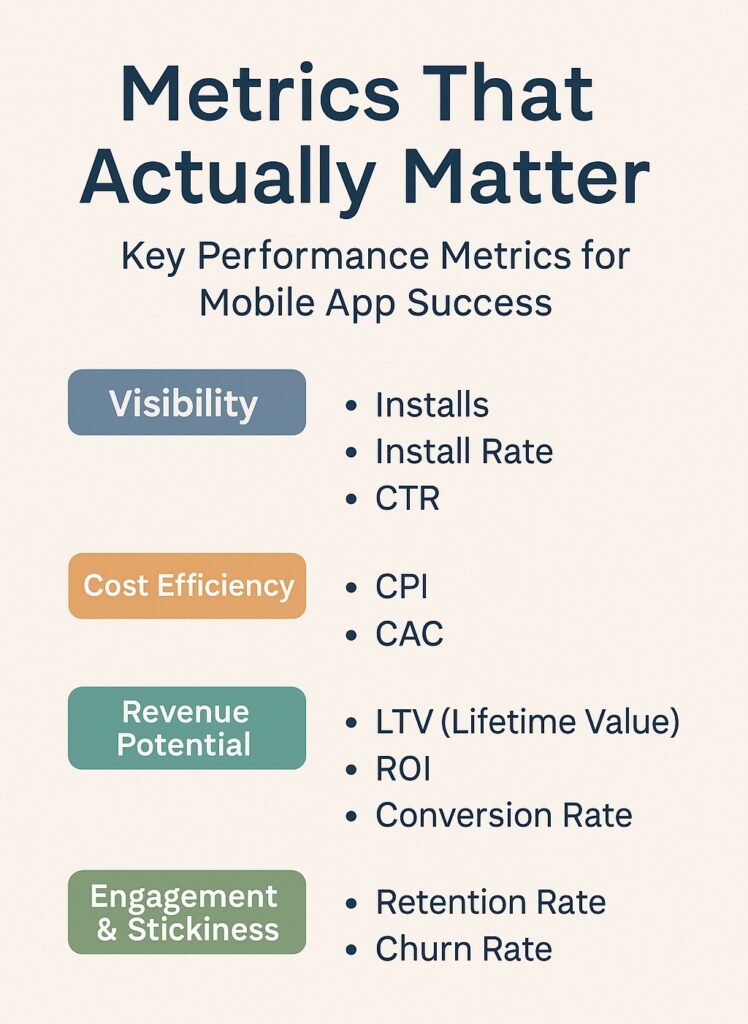
Let’s walk through the essential KPIs, grouped by what they tell you.
🚦 Phase 1: Are People Actually Installing Your App?
Take Strava, an app built specifically for runners and cyclists. With ~95 million registered athletes and a premium subscription model, Strava generates over $100M in annual revenue — all with a fraction of a mass-market user base. Similarly, Calm, focused on meditation and mental wellness, drives $150M+ yearly revenue from a loyal subscriber base with retention rates exceeding 60% annually.
1. Number of Installs :
The most basic metric — but don’t let it fool you. High install volume without retention is just vanity.
2. Install Rate (Impressions to Installs) :
If 10,000 people saw your ad but only 300 installed the app, something’s off — either your creative, your targeting, or your App Store listing.
🔍 Benchmark to aim for: A healthy install rate is often around 1–2% for cold traffic. ASO-optimized pages can push that to 4–6%.
💰 Phase 2: What’s It Costing You to Acquire a Real User?
3. CPI (Cost Per Install) :
How much are you paying for a single download? This number fluctuates based on platform and niche.
- 📱 Gaming apps: Average CPI ranges from $1.50–$4.00
- 💼 Finance apps: Often higher, up to $7–$10
4. CAC (Customer Acquisition Cost) :
Broader than CPI — CAC includes ad spend, creative production, influencer payments, etc., divided by the number of converted users.
🧠 Smart tip: Track both CPI and CAC. A cheap install doesn’t mean a profitable user.
💎 Phase 3: Are These Users Bringing Value?
5. LTV (Lifetime Value) :
This is the north star. LTV estimates how much revenue a single user will generate during their lifetime.
🪙Golden Rule: If LTV > CAC, you’re in the green. If not? You’re scaling losses, not revenue.
6. CAC (Customer Acquisition Cost) :
Are users signing up? Subscribing? Making a purchase? Downloads mean nothing if users don’t complete key actions.
- For freemium apps, track free-to-paid conversions.
- For e-commerce, track purchase completion post-install.
🧠 Search is how most users discover value inside your app.
Learn how an intelligent in-app search boosts engagement: In-App Search: The Hidden Hero of Great App Experiences
🔄 Phase 4: Are Users Sticking Around?
7. Retention Rate (Day 1, Day 7, Day 30) :
A crucial signal for onboarding effectiveness and product-market fit.
📊 Retention benchmarks (by app type) –
- Day 1: 25–30%
- Day 7: 10–15%
- Day 30: 5–10%
✨ Great UX isn’t optional anymore — it’s the foundation of retention.
Discover how design thinking drives long-term app success: Why UX is Critical in App Development for 2025 and Beyond
8. Churn Rate :
The flip side of retention. If users drop off fast, it’s a red flag that something — UX, performance, or value — isn’t landing.
📈 Phase 5: Is Your Marketing Actually Converting?
9. CTR (Click-Through Rate) :
If no one’s clicking your ad, you’re wasting impressions. A low CTR can mean weak creative or irrelevant targeting.
10. ROI (Return on Investment) :
🔍 Note: A campaign might bring lower installs but higher ROI — especially if it attracts high-LTV users.
📈 Not sure which metrics matter most for your app’s growth?
This guide breaks it all down — benchmarks, formulas, and tips: How to Measure the Success of Your App
🔧 Bonus Tip: Use the Right Tools to Track Everything
Don’t just rely on ad platform dashboards — they often show skewed results to make their own channel look good.
Instead, use a Mobile Measurement Partner (MMP) like:
- Adjust
- Appsflyer
- Branch
- Singular
They unify data across platforms and give you unbiased insights into where your best users are really coming from.
Growing a successful app in 2025 isn’t just about getting more downloads — it’s about getting the right users and keeping them engaged.
By using a smart mix of organic and paid strategies, tracking what truly matters, and constantly improving based on real data, you can build an app that not only survives but thrives.
Start small, stay consistent, and focus on value — because sustainable growth isn’t built overnight, but with the right plan, it’s absolutely possible.
🚀 Ready to build an app that users love and your business grows from?
Explore our full range of digital solutions innovination.com — or reach out for a personalized consultation.

![Master App Retention: 7 Insights from 3 Leading Apps for Growth [year]](https://www.innovination.com/wp-content/uploads/2025/06/Picture1-150x150.jpg)