
Mass-Market vs Niche Mobile Apps: Where’s the Real ROI Today?
Updated at: June 17, 2025

Think of Bollywood and YouTube.
On one hand, you have dazzling mega-productions made for the masses, driven by star power and huge budgets. On the other, you have creators on YouTube — often solo, low-budget, but laser-focused on niche audiences. One chases scale, the other thrives on connection.
Yet in 2025, it’s often the YouTuber, not the Bollywood studio, earning higher ROI per viewer.
The world of mobile apps mirrors this shift.
Once, app success was measured by millions of downloads and a spot on the App Store’s charts. But today, with rising acquisition costs and decreasing user attention, ROI is no longer about how many users you get — it’s about how deeply those users care.
In this blog, we’ll dive into the real ROI debate of the mobile world: should you go mass-market, or niche? Backed by data, insights, and real-world comparisons — Spotify vs Strava, TikTok vs Calm — we’ll show you why niche mobile apps aren’t just surviving, they’re beating the traditional ROI game.
Because in 2025, success is measured not by numbers, but by true value.
-
Historic ROI: The Numbers Game of Mass-Market Apps
How Big Downloads Once Meant Big Profits -
How Niche Mobile Apps Are Beating Traditional ROI Models in 2025
Why Smaller Audiences Deliver Bigger Returns -
ROI Breakdown: Mass-Market vs Niche Mobile Apps (2025)
Side-by-Side Comparison of Key Metrics -
When Should You Go Big (Mass-Market) vs Go Focused (Niche)?
Choosing the Right Strategy for Your App Vision -
Smart Moves to Boost ROI: Practical Tips That Work for Both Models
Actionable Steps to Maximize App Performance
Historic ROI: The Numbers Game of Mass-Market Apps📈
For a long time, mobile app ROI was all about the numbers game.
The formula was simple: build for everyone, go viral, get millions of downloads — and the money would follow. The wider your net, the more ads you could show, the more in-app purchases you could offer, and the more data you could collect.
It worked. At least, back then.
Apps like WhatsApp, Instagram, and Candy Crush rode this wave to global domination.
WhatsApp scaled to over 2 billion users with minimal monetization and was still acquired by Facebook for a staggering $19 billion. Instagram’s universal appeal turned it into a cultural
juggernaut. Candy Crush monetized through sheer addictive volume, turning casual players into consistent revenue streams.
The core ROI model here relied on:
- High user volume to offset low per-user revenue.
- Ad-based monetization and in-app microtransactions.
- Network effects to fuel viral growth and retention.
But in today’s crowded app stores, that model is cracking. User acquisition costs have skyrocketed. Competition is fierce. And retention is a battle — mass-market apps now lose users faster than ever.
The big question in 2025? Is going broad still worth the burn?
🧠 How Niche Mobile Apps Are Beating Traditional ROI Models in 2025
In today’s mobile app landscape, a new ROI model is rising — and it doesn’t chase millions. It chases meaning.
Niche mobile apps are proving that you don’t need a massive audience to be massively profitable. You just need the right users.
Unlike mass-market apps that aim for quantity, niche apps focus on quality — deeply serving a specific audience with tailored features, personalized content, and tight communities. The result? Lower churn, higher engagement, and far better monetization per user.
Take Strava, an app built specifically for runners and cyclists. With ~95 million registered athletes and a premium subscription model, Strava generates over $100M in annual revenue — all with a fraction of a mass-market user base. Similarly, Calm, focused on meditation and mental wellness, drives $150M+ yearly revenue from a loyal subscriber base with retention rates exceeding 60% annually.
Here’s why niche apps win the ROI game:
- Lower User Acquisition Cost (CAC): Targeted marketing = less ad spend.
- Higher Customer Lifetime Value (CLV): Niche users pay more and stay longer.
- Superior Retention: With churn rates lower and engagement higher, niche apps build loyalty faster.
- Focused Monetization: Most profitable niche app ideas monetize through subscriptions and premium features—not ads.
In fact, niche apps show conversion rates around 6%, nearly 3–4x higher than mass-market apps (which average just 1.5–2%).
And the Average Revenue Per User (ARPU)? A niche app can pull in $4.30/user, compared to $1.22/user from mass-market apps!
Wondering why does it work?
Niche mobile apps feel personal. They solve specific problems and often build communities that users want to return to daily. And in a time when user retention strategy is everything, app ROI isn’t about how many users you attract — but how many stick around and pay.
⚖ ROI Breakdown: Mass-Market vs Niche Mobile Apps (2025)
| Metric | Mass-Market Apps | Niche Mobile Apps |
| User Acquisition Cost (CAC) | High – broad targeting, expensive ads | Low to Moderate – focused, efficient targeting |
| Churn Rate | High – users often disengage quickly | Low – strong relevance = long-term stickiness |
| Customer Lifetime Value (CLV) | ~$30 | ~$85 |
| Average Revenue Per User (ARPU) | ~$1.22 (ad-based) | ~$4.30 (subscriptions, premium features) |
| Conversion Rate | 1.5%–2% | ~6% |
| Monetization Strategy | Ads, In-App Purchases | Subscriptions, Premium Features |
| App User Retention Strategy | Broad features = shallow engagement | Personalized experience = deep engagement |
| Community Engagement | Broad, shallow | Deep, loyal – often built-in via features |
| Development Cost | High – needs robust infrastructure + wide UX/UI | Lower – leaner builds, focused features |
| Profitability Timeline | Slower – higher cost, longer runway | Faster – quicker ROI with lower upfront spend |
| Best ROI Model Fit | Requires large scale for ROI | Suited for sustainable, high-ROI per user |
If you’re looking to build a profitable mobile app with lower risk and faster ROI, the niche model may be your strongest bet in 2025 — especially with rising acquisition costs and competition eating into traditional models.
Want these ROI numbers to work in your favor?
From lean MVPs to scalable enterprise solutions, Innovination builds custom apps designed to maximize your ROI — fast.
🧭 When Should You Go Big (Mass-Market) vs Go Focused (Niche)?
Not every app is meant to dominate the App Store — and not every niche app needs millions to succeed. The right path depends on your app development strategy, budget, target audience, and monetization goals.
Curious how to track whether your app strategy is really working?
Don’t miss our guide on How to Measure the Success of Your App — packed with benchmarks, metrics, and expert tips.
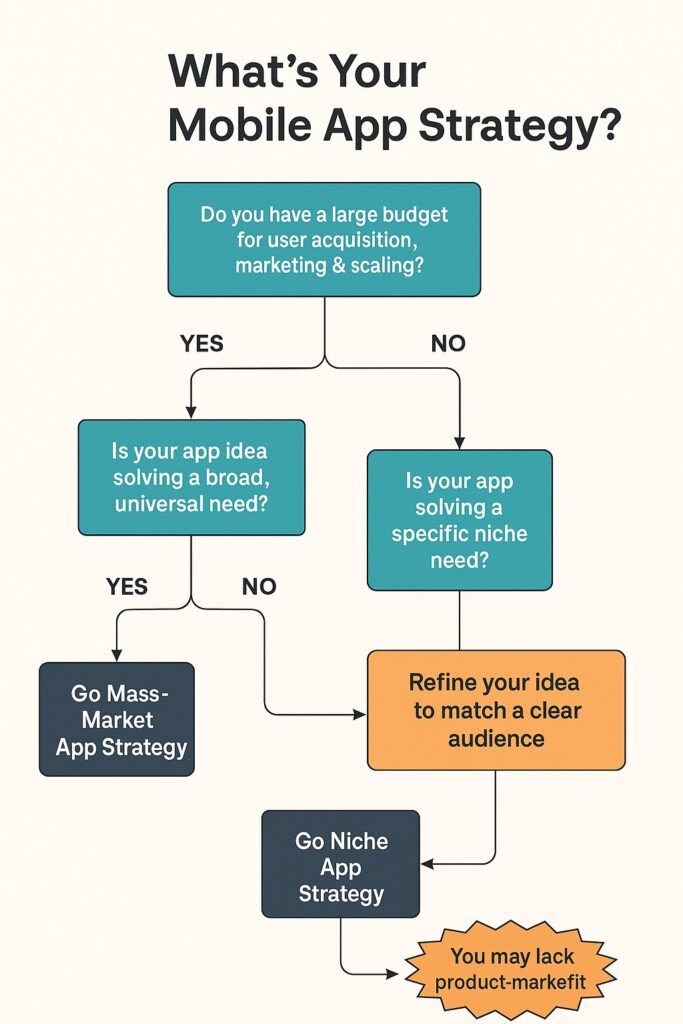
✅ Go Mass-Market If:
- You have strong funding and can support high customer acquisition costs (CAC).
- Your app solves a universal problem (e.g., messaging, payments, general fitness).
- Your monetization model is ad-based, freemium, or relies on viral growth.
- You’re prepared to scale infrastructure, UX/UI, and support systems.
- Your vision includes becoming a household name in a competitive space.
Best ROI Model: Freemium + Ads + In-App Purchases
✅ Go Niche If:
- You have limited funding or want lean operations with faster ROI.
- Your app targets a specific segment with clear pain points (e.g., runners, educators, diabetics).
- Your monetization model is built on subscriptions, micro-communities, or premium features.
- You want high user retention, stronger LTV, and sustainable growth.
- Your goal is to become the go-to app for a specific problem or tribe.
Best ROI Model: Subscription-Based + Deep Engagement Features
Choosing a niche app strategy doesn’t mean thinking small — it means thinking smart. Apps like Calm, Strava, and Blinkist prove that focused value creates deep loyalty and powerful, long-term ROI.
Not sure whether your app idea fits a mass-market or niche model?
Our product strategists at Innovination help startups and enterprises validate, design, and launch ROI-focused mobile apps.
Smart Moves to Boost ROI: Practical Tips That Work for Both Mass-Market and Niche Apps
No matter what kind of app you’re building—one meant for the masses or designed for a niche audience — boosting your return on investment (ROI) is always the goal. But how do successful app developers actually get there?
It turns out, the path to higher ROI shares a few common checkpoints. Let’s break them down in simple terms.
1. Let Data Lead the Way
Your app already collects a ton of useful information — how users interact with it, where they drop off, what they love. Don’t let that data go to waste.
Use analytics tools to dive deep into user behavior. This insight helps you fine-tune features, streamline marketing, and even decide which bugs or pain points to fix first.
Want to level up your app’s discoverability and user flow?
Check out In-App Search: The Hidden Hero of Great App Experiences to see how one underrated feature can transform engagement and retention.
2. Design a Delightful Experience
Ever deleted an app just because it was clunky or confusing? You’re not alone.
A smooth, intuitive user experience (UX) is one of the most powerful ways to boost ROI. If users find your app enjoyable and easy to navigate, they’re much more likely to stick around — and even spread the word.
Great design isn’t just about looks — it’s about conversions, retention, and ROI.
Learn why UX is your competitive edge in our latest post: Why UX Is Critical in App Development for 2025 and Beyond .
3. Serve Up Personalization
Here’s where niche apps can really shine. By leveraging AI and machine learning, you can offer personalized content, product suggestions, or user journeys that feel tailor-made.
This level of customization doesn’t just impress users — it drives better conversion rates and keeps them coming back.
4. Get Smart About User Acquisition
Spending money on ads without a clear plan is like pouring water into a leaky bucket. Instead, focus on targeted advertising and smart SEO tactics that bring in users who actually need your app.
For niche apps, this approach is even more effective, since you’re speaking directly to a defined, interested audience.
5. Create a Loyal Community
Loyal users aren’t just great customers — they’re also your best marketers. Build social features, encourage feedback, and roll out regular updates that show you’re listening.
This kind of engagement is especially powerful for niche apps, where users often value the sense of belonging and active participation.
Whether you’re scaling up a mass-market app or nurturing a niche idea, these strategies can help you move the ROI needle in the right direction.
The key is to be intentional: listen to your data, care about your users, and keep evolving. In today’s crowded app marketplace, that’s what sets successful apps apart.
Your app deserves more than downloads — it deserves loyal users and lasting ROI.
Partner with Innovination, and let’s turn your idea into a high-impact mobile experience that grows with you.

![Mobile App User Acquisition in [year]: Winning Strategies for a Crowded Marketplace](https://www.innovination.com/wp-content/uploads/2025/06/img1-150x150.jpg)