In-App AI: The Evolution of Apps in 2026 and Beyond
Updated at: July 8, 2025

There was a time — not too long ago — when even a simple Google search was a multi-step process.
Back then, smartphones weren’t in everyone’s pockets. Most of us used dumbphones that made searching the web feel like a mission. You’d have to open your browser, manually type in “google.com,” and then type out your query!
Just getting an answer felt like work. 🤮
Smartphones changed that. To make things quicker, they started placing Google search bars right on home screens as widgets. One tap, and you could start searching instantly.
Then came voice search — just say it, and Google would find it. The barriers kept dropping, and the convenience kept growing.😎
Now, we’re stepping into the next chapter: the age of AI.
But this time, it’s not just about faster access — it’s about smarter, more personalised answers. AI is designed to give you pin-point answers to pin-point questions, right inside the apps you already use.
The future of app navigation isn’t just speed. It’s apps that understand you, anticipate you, and work with you — often before you even lift a finger.
- Introduction: The Evolution of Apps – From Search to AI
- What is AI in Apps? The Assistant You Didn’t Know You Needed
- AI in Different Apps: Real-Life Examples
- Case Study: How Domino’s is Winning with In-App AI
- How AI Works in Mobile Apps: The Magic Behind the Tap
- The Future of AI in Mobile Apps: What’s Next?
- What This Means for Future Apps
- Conclusion: The Future is Intuitive
What is AI in Apps? It’s the Assistant You Didn’t Know You Needed.
Think about this:
You open your favourite shopping app and it already knows the kind of colours you like.
Your fitness app nudges you with the perfect 20-minute workout just when you were thinking about squeezing one in.
Your music app starts playing your comfort playlist before you even search for it.
That’s not magic. That’s AI in apps quietly working behind the scenes.
Samsung is already showing us what’s possible. Their phones can now scan an image or video, identify the product, and search for pricing and details across the web — all in seconds by just circling it. That’s not a dream feature. That’s already here. 👇

When most people search for “what is AI in apps” or “what can AI apps do,” they imagine a smart search bar or maybe an AI chatbot. But AI in mobile apps is so much more.
It’s about building apps that understand you, learn from you, and adapt to you — sometimes even before you ask.
In AI messaging apps, it’s like texting with a friend who finishes your sentences.
In AI fitness apps, it’s like having a personal trainer who knows your exact energy level each day.
In AI navigation apps, it’s the friend who always knows the best shortcut home. In AI music apps, it’s a DJ that matches your mood without you saying a word.
In AI education apps, it’s a patient tutor who adjusts the lesson until you truly get it.
Even creative platforms like Canva and Adobe apps are jumping in — you can now remove backgrounds, auto-design templates, and get instant AI-powered suggestions with just a tap.
And it’s not just the big names. Everyday people on Reddit and Quora are asking “how to use AI in mobile app” because they know the next big thing is already happening —
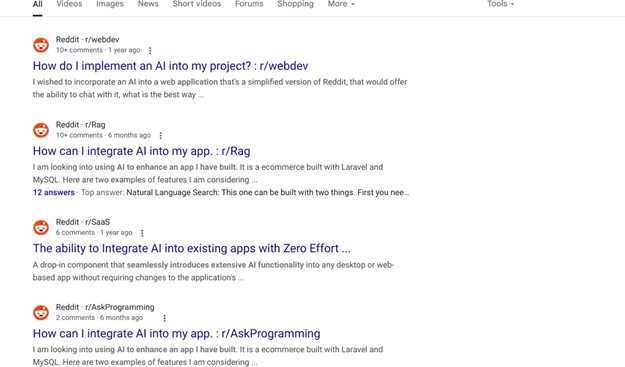
The truth is, AI in different apps is quietly reshaping the way we use our phones. We’ve moved past search. We’re now building apps that understand us.
And the future?
It’s not about tapping. It’s about asking. It’s about speaking. It’s about your app simply knowing.
How AI is Already Changing Apps: Real Stories, Real Impact
AI isn’t some futuristic concept waiting to arrive. It’s already here — reshaping the apps you use every day in ways you might not even notice.
When you ask “how to use AI in apps,” the truth is, you probably already are.
Look at Google Search.
Today, when you search for something, the first thing you often see isn’t a list of blue links. It’s Gemini — Google’s AI — giving you a direct, conversational answer right at the top of the SERP (Search Engine Results Page).
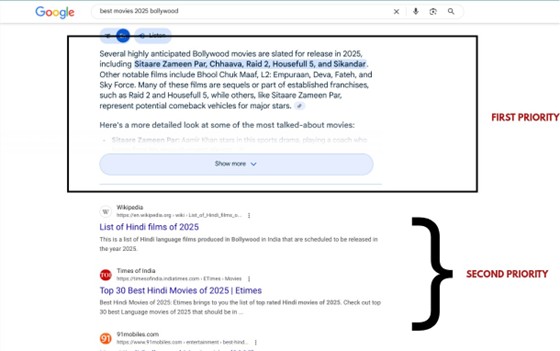
The AI response now comes before the websites.
That’s not a search bar anymore. That’s an in-app AI assistant built to get you faster, more specific answers. It’s a perfect example of what AI apps can do: move from search to solution in a single step.
This shift is quietly happening across industries. Let’s explore another great example.
🍕 Deep Dive: How Domino’s Hits the AI Sweet Spot
Domino’s isn’t just a pizza company anymore. It’s a tech-forward innovator that’s redefined how users interact with their service app, powered by AI.
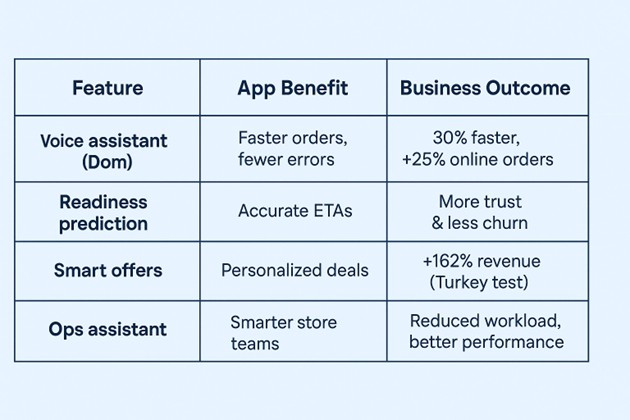
1. Faster, Smarter Voice Ordering with “Dom”
Remember how you used to dial for pizza? Now meet Dom, Domino’s AI-powered assistant — on your phone, Alexa, or Google Assistant.
- Using NLP (natural language processing), Dom understands your order intent and preferences.
- Implementation led to 30% faster order processing and 25% more online orders overall.
- Voice orders used to feel clunky. Now you can say, “Large cheesy pizza with sides like cheesy garlic bread and crispy chicken,” and get it right — without human error.
It’s not just convenience. It’s a smarter buying journey.
2. Predicting Order Readiness with AI
Domino’s feeds real-time data — staff count, order backlog, traffic — into AI systems powered by NVIDIA GPUs.
- Their model reduced prediction errors from 75% to 95% accuracy in estimating when your pizza is ready.
- No more uncertainty — your app not only tracks your pizza, but knows when it’ll exit the oven.
This is in-app AI assistant reality, guiding users through every step.
3. Customised Offers and Dynamic Menu
Forget generic deals. Domino’s uses AI to tailor offers based on your history, time of day, location, and even local supply.
- A/B testing on app-driven menu recommendations (powered by Segmentify) raised revenue by a 162% uplift in Turkey alone.
- Across communications, AI-personalised marketing reduced message delivery time by 38%, boosting engagement.
This is AI in mobile apps — not just reacting but predicting your next crave.
4. Generative AI for Employees
In 2023, Domino’s teamed up with Microsoft and Azure OpenAI to build a generative AI assistant for store operations:
- Helps staff with inventory, scheduling, and quality control.
- Frees store managers from routine queries—letting them focus on making better pizza and service.
AI isn’t just built for customers — it’s optimizing behind-the-scenes too.
How AI Works in Apps: The Magic Behind the Tap
AI in apps might feel like magic, but behind the curtain, there’s a smart system working fast, learning constantly, and improving every tap, swipe, and command.
So how does AI actually work in mobile apps?
When you open an app with AI features, here’s what’s usually happening:
- The app collects data — your clicks, your preferences, your voice, your location, your history.
- It sends this data through AI algorithms that can learn patterns, predict what you might want next, and understand your habits.
- Then it feeds that prediction right back to you — in the form of smart search results, personalised suggestions, faster navigation, voice-powered actions, or even AI chat assistants.
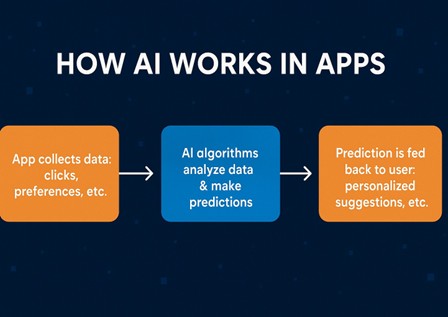
It’s like your app is building a mini-map of your choices to make the next step faster, easier, and more relevant.
🔍 Three Core AI Processes Inside Apps:
Domino’s isn’t just a pizza company anymore. It’s a tech-forward innovator that’s redefined how users interact with their service app, powered by AI.
| AI Process | What It Does | Example |
|---|---|---|
| Machine Learning | Learns from your app usage and personalizes the experience | Spotify suggesting songs |
| Natural Language Processing (NLP) | Understands voice and text commands | Voice search in Google, chat in WhatsApp |
| Computer Vision | Recognizes images, objects, and faces | Samsung’s product scanning, YouCam’s AR try-ons |
The Future of AI in Mobile Apps: What’s Next?
If today’s AI in mobile apps feels fast, the future will feel almost… effortless.
We’re heading toward a world where apps won’t wait for you to search, swipe, or type. They’ll know what you need, when you need it.
Here’s what’s coming next in the world of AI-powered apps:
🎙️ Voice-First Navigation Will Take Over
Soon, we’ll tap less and talk more.
AI-powered apps are moving towards voice-first experiences where simple commands will instantly change app settings, complete tasks, or even switch colour themes.
Imagine telling your favourite design app, “Set this to a midnight blue theme,” and watching it change in real time. That’s how to use AI in mobile apps of the future — with natural, seamless voice interaction.
🧑🤝🧑 In-App AI Friends Are on the Rise
Apps with AI friends and AI chat companions are already popular, but they’re about to become more emotionally intelligent.
Think beyond smart replies.
We’re talking about apps that understand your mood, remember past conversations, and offer companionship in a way that feels personal and real.
Soon, when people search for “app with AI friend,” they’ll find apps that actually grow with them.
🎯 Hyper-Personalization in Real Time
Today’s apps offer recommendations. Tomorrow’s apps will transform in real time.
Your fitness app will update your routine based on your last 30 minutes. Your learning app will adjust difficulty on the go.
Your messaging app will set colour themes based on your preferences without you lifting a finger.
AI apps will personalise not just content—but the entire app experience.
🔄 One AI Profile Across Apps
Soon, apps won’t work in silos.
Your in-app AI assistant will move with you across platforms.
Your AI chat in your shopping app will already know your music taste, your workout patterns, and your travel preferences—because the AI will sync across your ecosystem.
This is where AI in different apps will truly become one interconnected experience.
📴 Offline AI Will Be the New Standard
AI apps today rely heavily on cloud computing. But in the future, apps with AI will get smarter locally.
That means faster response times, less internet dependency, and better privacy.
Your phone’s in-app AI assistant will soon handle complex tasks even when you’re offline.
🔍 Visual Search Will Explode
Samsung’s product recognition was just the beginning.
In the future, visual search will power AI apps across industries: travel, fitness, fashion, education.
Just point your camera, and your app will tell you what something is, how much it costs, where to find it, and what alternatives exist — without you typing a single word.
✅ What This Means for Future Apps
If you’re building an app in 2025 and beyond, AI is no longer a bonus — it’s the baseline.
- People are already searching: “How to use AI in apps,” “AI apps in fitness,” “AI apps in education,” “apps with AI chat.”
- Users now expect smart, personalised, predictive experiences in every category.
The winners will be the apps that:
- Anticipate.
- Personalise.
- And most importantly — feel like they “get” you.
Conclusive Thought
The future of apps isn’t just smart — it’s intuitive, personal, and effortless. AI isn’t a feature; it’s the new heartbeat powering every tap, swipe, and word.
In 2025 and beyond, apps won’t wait for you to ask — they’ll already know. So if you want to stay ahead, it’s time to embrace AI as your app’s secret weapon, turning ordinary experiences into truly magical ones.
![Master App Retention: 7 Insights from 3 Leading Apps for Growth [year]](https://www.innovination.com/wp-content/uploads/2025/06/Picture1-150x150.jpg)
![AI-driven Data Privacy & Security Risks in apps ([year])](https://www.innovination.com/wp-content/uploads/2025/07/Firefly_Gemini-Flash_the-image-is-pxelated-make-it-clear-47024-150x150.png)